

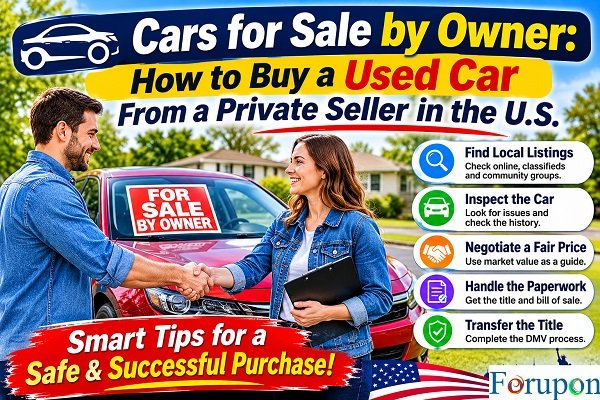
Cars for Sale by Owner: How to Buy a Used Car From a Private Seller in the U.S.
Cars for sale by owner are used vehicles sold directly by their current owner instead of a dealership. You can often negotiate a better price, but you also take on the inspection, the fraud screening, and the paperwork yourself, and the sale is usually “as is.”
This guide covers where to find owner listings, what to check before you pay, how to avoid the most common scams, and how to finish the title transfer. It is written for U.S. buyers. Rules differ by state, so confirm the final steps with your state’s motor vehicle agency. This is general information, not legal advice.
What does “for sale by owner” mean for cars?
A car “for sale by owner” is a used vehicle offered by an individual, not by a licensed dealer. This is also called a private-party sale. The seller sets the price, answers your questions, and signs over the title.
This category is almost entirely used cars. If you are comparing new cars for sale at dealerships against a private purchase, the trade-offs are different: new cars come with a manufacturer’s warranty and dealer financing, while owner sales trade that support for a potentially lower price. The comparison table later in this guide lays out the differences.
Is buying a car from a private seller worth it?
It can be, if you are willing to do the homework. The main appeal is price and directness. The main cost is that you carry the risk.
| Advantages | Drawbacks |
|---|---|
| Prices are often lower than comparable dealer cars, and you can negotiate directly | Sales are generally “as is,” with no dealer warranty |
| You can ask the owner about maintenance and driving history | Federal dealer disclosure rules do not apply (see below) |
| Typically avoids dealer add-on fees | You handle title, registration, and taxes yourself |
| Wide range of older and niche vehicles | Higher exposure to fraud and misrepresented cars |
| No on-site financing or trade-in |
Why more buyers look here. Edmunds’ Q2 2026 report found the average transaction price of a three-year-old used vehicle hit a second-quarter record of $32,461, and that vehicles priced under $20,000 made up 31.8% of used sales, down from 55.2% in Q2 2019. These are figures for used sales overall, not private sales specifically, but they explain why budget buyers are widening their search.
Where can you find cars for sale by owner?
| Source | What to know |
|---|---|
| Facebook Marketplace, Craigslist | Large local inventory, minimal vetting. Fraud screening is on you. |
| Cars.com, Autotrader | Offer private-seller listings alongside dealer inventory. Autotrader states that listing information comes from the seller, not from Autotrader. |
| iSeeCars | Aggregates owner listings with price bands and market-value flags. |
| eBay Motors | Auction and fixed-price listings. The FTC has warned about fake used-car ads on auction sites. |
| Private-sale platforms such as PrivateAuto | Add tools for paperwork and payment. Review their terms and fees like any service. |
No platform guarantees that a seller or a car is what the listing claims. Treat every listing as unverified until you have checked the title and the VIN yourself.
How to buy a car from a private seller, step by step
1. Set a total budget
The asking price is not the full cost. Add sales tax, title and registration fees, insurance, an inspection, and a cushion for near-term repairs. Decide your walk-away number before you contact anyone.
2. Check the market value
Look up the car on at least two valuation tools (Kelley Blue Book, Edmunds, or J.D. Power) using the exact trim, mileage, and condition, and choose the private-party value rather than dealer retail. Then compare against similar local listings. A price far below both is a warning sign, not a bargain.
3. Screen the seller before you meet
Send these questions first. A legitimate owner answers them easily.
- Is the title in your name, and can you send a photo of it with the VIN visible?
- Is there a loan or lien on the car?
- Why are you selling, and how long have you owned it?
- Are there service records?
Search the seller’s phone number. If it appears on several listings for different cars, you may be dealing with an unlicensed dealer (see red flags below).
4. Run the VIN
The 17-character VIN is on the dashboard near the windshield and the driver’s door jamb. Check that it matches the title and the car itself.
- NHTSA’s free VIN lookup shows open safety recalls. Recall repairs are free at an authorized dealer, but a car with unrepaired recalls may have been neglected.
- A vehicle history report (Carfax, AutoCheck, or an NMVTIS-approved provider) can show title brands, reported accidents, and odometer readings.
- NICB’s free VINCheck screens for theft and total-loss records.
Reports only include what was reported. A clean report does not prove a clean car, which is why the next steps matter.
5. Meet safely and test drive
Meet in daylight at a public place, bring someone with you, and match the seller’s photo ID to the name on the title. Confirm your insurance covers you before you drive. On the test drive, check cold start, braking, steering pull, transmission shifts, warning lights, and air conditioning, and drive on both city streets and a highway.
6. Get an independent inspection
A pre-purchase inspection by a mechanic you choose typically costs about $100 to $300, depending on the shop and how deep the inspection goes. Do not use the seller’s recommended mechanic. If the seller refuses an inspection, walk away.
The report is also a negotiating tool. Repair estimates for problems the mechanic finds can justify a lower price.
7. Negotiate
Start from the private-party value, subtract documented repair needs, and keep the conversation factual. Be ready to leave. Another owner is always selling a similar car.
8. Pay safely
Pay only when you are holding the signed title, ideally in one sitting at a bank branch so funds can be verified and the seller can confirm receipt.
Related Posts
- Never pay by wire transfer, gift card, or cryptocurrency to someone you have not met. The FTC says a demand for gift cards or wire payment in a car sale is a scam.
- Be wary of any “escrow” or shipping company that the seller proposes. Fake escrow sites are a known fraud tactic.
- Get a receipt that states the amount paid.
9. Finish the paperwork
Get the signed title, a bill of sale, and the odometer disclosure. The next section lists what each document does.
What documents do you need?
| Document | Why it matters |
|---|---|
| Certificate of title | Proves ownership. The seller signs it over to you. The seller’s name must match it. |
| Bill of sale | Records price, date, VIN, and both parties. Some states require it, and some require notarization. |
| Odometer disclosure | Federal law requires a mileage statement when ownership transfers for vehicles model year 2011 or newer, for 20 years. Model year 2010 and older are exempt federally, but some states still ask for it. |
| Lien release | Required if there was a loan. Proves the lender no longer has a claim. |
| “As is” language | A line in the bill of sale documenting that no warranty was given. |
| Proof of insurance | Most states require it to register the car. |
Odometer fraud is a federal crime. Entering a false mileage on a transfer document can carry serious penalties for the person who does it.
Can you buy a car the seller still owes money on?
Yes, but only if the lien is cleared as part of the sale. The lender usually holds the title, so you cannot receive it until the loan is paid.
The safest approach is to complete the sale at the seller’s lender (or a branch of it). You pay the lender the payoff amount, the lender releases the lien, and the seller receives any difference. Confirm the process with the lender before you hand over money. Never accept the seller’s promise to “pay it off later.”
Red flags and common scams
Walk away if you see any of these:
- The seller will not show the title, or the title is not in their name. A legitimate private seller normally holds the title. A seller who “is selling for a relative” is a classic curbstoning pattern.
- The same phone number appears on multiple listings.
- The seller refuses an in-person inspection or insists on delivery only.
- A price far below market, paired with pressure (“another buyer is coming today”).
- Requests for wire transfers, gift cards, or crypto, or a seller-chosen escrow site.
- Odometer reading that does not match wear, service records, or the history report.
- A meeting place other than the seller’s home that the seller pushes hard (Utah’s DMV lists this among curbstoning signs).
Fake dealership websites. In September 2026, the FTC warned that scammers are spoofing car dealership websites to take payment for cars that do not exist. The agency says to be particularly cautious when a seller insists on payment by wire transfer.
Curbstoning. This means an unlicensed dealer posing as a private seller. State attorneys general, including Minnesota’s, warn that these sellers advertise on free classified sites. The risk is that you lose the protections that apply to licensed dealers and may inherit title problems.
Odometer rollbacks and title problems. AARP lists odometer rollback among traditional used-car schemes. A VIN history check and an independent inspection are your best defenses.
If you are targeted, report it at ReportFraud.ftc.gov and to your state attorney general.
What protection do you have if something goes wrong?
Very little compared with a dealer purchase, which is why prevention matters.
- The FTC Used Car Rule applies to dealers, not individuals. Dealers must post a Buyers Guide on used cars. Private sellers are not required to use it. The rule covers sellers of more than five used vehicles in a 12-month period.
- Private sales are generally “as is.” Unless the seller gives you a written warranty, assume you own any problem the moment you sign.
- Lemon laws generally do not cover private sales. State used-car lemon laws that exist apply to dealer sales.
- Fraud is different. If a seller knowingly lied about a material fact such as the odometer reading, a salvage title, or flood damage, you may have legal claims. Keep every message, ad screenshot, and receipt, and consult a consumer attorney or your state attorney general’s office.
Private seller vs. dealer-used vs. new: how do they compare?
| Private seller | Dealer-used | New (dealer) | |
|---|---|---|---|
| Typical price | Often lowest for the same car | Higher, includes dealer costs | Highest |
| Warranty | Usually none (as is) | Varies; Buyers Guide discloses it | Manufacturer warranty |
| Legal disclosures | None required federally | Buyers Guide required | Standard new-car sale documents |
| Paperwork | You | Dealer | Dealer |
| Financing | Arrange yourself | On site | On site |
| Fraud risk | Higher | Lower | Lowest |
The general pattern is that you pay less when you take on more risk and work. If you shop new cars for sale and used owner listings side by side, compare total cost, including the repairs you may face on an older car, and not only the price tag.
Taxes, fees, and deadlines
- Sales tax: The buyer usually pays it to the state when registering the car, not to the seller. A few states, including Alaska, Delaware, Montana, and New Hampshire, do not charge general sales tax on vehicle purchases. Confirm your state’s rules.
- Don’t understate the price. Writing a lower price on the bill of sale to reduce tax is a bad idea. Some states tax based on book value regardless of the price you write, and a false price can create legal trouble for both parties.
- Deadlines and fees vary by state. Many states require you to transfer the title and register within a set window, often measured in days or weeks, and some charge penalties for late transfers. The seller may also have to notify the DMV of the sale (California gives sellers five days, for example). Check your DMV’s site before the sale, not after.
The bottom line
Buying a car from an owner can save money, but only if you verify four things before paying: the seller owns the car, the VIN matches the title and history, an independent mechanic has inspected it, and you can pay in a way that is traceable and tied to receiving the signed title. If any of those fails, walk away. A cheaper car is not a bargain if you cannot legally put it in your name.
Part 12: FAQ Section
Is it cheaper to buy a car from a private seller? Often, yes, because you avoid dealer overhead and add-ons. But you give up warranties and legal protections, so budget for an inspection and possible repairs.
Can I finance a car bought from a private seller? Yes. Many banks and credit unions offer private-party auto loans, but the process differs from dealer financing. Get preapproved and ask the lender how it handles the title and payment to the seller.
Do I need a bill of sale? Not in every state, but you should always get one. It documents price, date, and the as-is nature of the sale, and your DMV may ask for it at registration.
Is paying cash safe? Large amounts of cash are risky for both sides and leave a weaker paper trail. A transaction at a bank branch, with a signed title and a receipt, is safer. Never pay by wire, gift card, or crypto to a stranger.
Do private car sales come with a warranty? Usually not. Unless the seller gives you one in writing, the car is sold as is. A remaining manufacturer’s warranty may or may not transfer, so check its terms.
Can I return a car I bought from a private seller? Generally no. Federal law does not give you a three-day right to cancel a car purchase, and private sales rarely offer returns. Your leverage is before you sign.
How do I know the car isn’t stolen or has a lien? Match the seller’s ID to the title, run the VIN through a history report and NICB’s VINCheck, and ask your DMV how to verify title status. Clear any lien through the lender before you pay.