

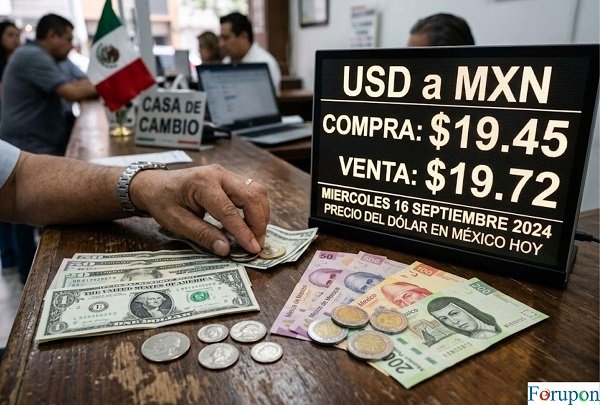
Dolar a Peso Mexicano: How to Convert US Dollars to Pesos (USD to MXN)
On November 27, 2026, Banxico’s official FIX rate was 19.6598 pesos per US dollar. At that rate, $100 converts to about 1,966 pesos. That is the benchmark number, not the number you will necessarily get. Banks, exchange counters and transfer apps each apply their own rate, and the gap can cost you more than any listed fee.
This guide explains how dolar a peso conversion works, which rate matters for your situation, why the peso has been volatile lately, and how to keep more of your money when you exchange or send dollars to Mexico.
Rates change throughout the day. Figures below are a snapshot from November 27, 2026. Check a live rate before you transact.
Dolar a Peso Today: The Current USD to MXN Rate
The peso has weakened sharply in recent months. The FIX rate was about 16.95 pesos per dollar in late August and reached 19.66 by November 27. One report said the peso had its weakest close in roughly 17 months on November 20. It then broke a streak of seven straight losing sessions on November 27, helped by profit-taking.
Here is the November 27, 2026 snapshot:
| Measure | Pesos per US dollar |
|---|---|
| Banxico FIX (determined Nov 27) | 19.6598 |
| Banxico end-of-day close | 19.6726 |
| Average bank “buy” quote in Mexico (bank buys your dollars) | about 19.40 |
| Average bank “sell” quote in Mexico (bank sells you dollars) | about 19.86 |
Sources are listed in the external source section. Individual bank quotes that day ranged widely, which is the main point of the next sections.
How to Convert Dollars to Pesos
The math is simple:
- Dollars to pesos: multiply the dollar amount by the exchange rate.
- Pesos to dollars: divide the peso amount by the exchange rate.
Example: $250 × 19.6598 = 4,914.95 pesos. In the other direction, 1,000 pesos ÷ 19.6598 = about $50.87.
Quick reference at the November 27 FIX rate of 19.6598:
| US dollars | Mexican pesos (approx.) |
|---|---|
| $1 | 19.66 |
| $10 | 196.60 |
| $20 | 393.20 |
| $50 | 982.99 |
| $100 | 1,965.98 |
| $250 | 4,914.95 |
| $500 | 9,829.90 |
| $1,000 | 19,659.80 |
These are reference conversions, not what a provider will pay you. Fees and markups come on top.
Which Exchange Rate Should You Use?
Short answer: use the mid-market or FIX rate as your benchmark, then judge every offer by how far it falls below that benchmark.
Three numbers circulate for the same day:
- FIX rate: Banxico determines it from wholesale market quotes and it is published in the Diario Oficial de la Federación (DOF). Mexican rules use it to settle dollar-denominated obligations. It is a reference rate, not a retail price.
- Interbank or mid-market rate: the wholesale rate banks trade at. Google and many converters show something close to this.
- Retail rate: what a bank, kiosk or app actually gives you. It includes a spread.
Why the rate you get is lower than the rate you see online
Retail providers earn money on the spread between the rate they buy at and the rate they sell at. In Mexico, quotes are labeled compra (the bank buys your dollars from you) and venta (the bank sells dollars to you). If you are a US traveler handing over dollars, the compra rate is the one that applies.
On November 27, one published bank table showed these compra quotes against a FIX of 19.66:
| Bank | Compra (what you receive per $1) | Gap vs. FIX |
|---|---|---|
| Banamex | 19.06 | about 3% lower |
| BBVA México | 18.79 | about 4% lower |
| Banorte | 18.50 | about 6% lower |
On a $500 exchange, 19.06 gives 9,530 pesos while 18.50 gives 9,250, a difference of roughly 280 pesos. Against the FIX benchmark of 9,830, the gap is larger. This is a one-day illustration from a single source. Quotes differ by branch and change constantly, so always check the posted rate before you hand over cash.
Why the Peso Moves Against the Dollar
No one can reliably predict where USD to MXN goes next. What reporting does show is what has been pushing it recently:
- A narrower interest-rate gap. Banxico cut its target rate by 25 basis points on November 5, bringing it to 6.25%, and has signaled it will hold there for a prolonged period. Market reports say a smaller rate gap with the US makes the peso less attractive to investors.
- US monetary policy expectations. Several reports tied the peso’s slide to expectations about Federal Reserve policy and a stronger dollar globally.
- Global risk sentiment. When stock markets fall, investors tend to move toward the dollar and US Treasuries, which pressures emerging-market currencies like the peso.
The practical takeaway: a rate you saw last week may not be available today. If you must exchange a fixed amount on a fixed date, do not rely on a rate you saw days earlier.
Where to Convert Dollars to Pesos
There is no single best option. The right choice depends on amount, timing and convenience.
| Option | Strengths | Watch out for |
|---|---|---|
| Withdraw pesos from a Mexican bank ATM with a US debit card | Rate is generally close to wholesale | ATM and home-bank fees; always decline the machine’s offer to charge in dollars |
| Credit or debit card purchases in Mexico | Convenient, protected, no cash to carry | Foreign transaction fees (many cards charge around 3%, some travel cards charge none); always choose to pay in pesos |
| Casa de cambio (exchange house) | Often better than airport counters if you compare posted rates | Rates vary widely; check the compra rate and any commission |
| Bank counter in Mexico | Safe and regulated | Compra quotes can sit several percent below the benchmark, as shown above |
| Airport kiosks | Fast | They tend to offer weaker rates; use only for small amounts |
| Exchanging at a US bank before you travel | Cash in hand on arrival | Rates and fees vary; compare to ATM withdrawals |
Related Posts
A common approach is to carry a small amount of pesos for taxis and tips, then use a card without foreign transaction fees for larger purchases. Compare options against the live mid-market rate before you commit.
Sending Money to Mexico: What US Senders Should Know
Sending dollars to be received as pesos adds three things to think about.
1. The exchange-rate markup. Some providers advertise low or zero fees but offer a weaker exchange rate. Compare the final peso amount the recipient will get, not just the fee.
2. The 1% federal remittance tax on cash-funded transfers. Since January 1, 2026, a 1% federal excise tax applies to remittances funded with cash, money orders, cashier’s checks or similar physical instruments. Transfers funded from a bank account, debit card or credit card are exempt. The provider collects the tax. BBVA Research reported that remittances to Mexico still reached about $14.5 billion in the first quarter of 2026, up 1.4% from a year earlier.
3. Your protections under US law. Under the CFPB’s remittance rule, providers must disclose the exchange rate, fees and taxes, and the amount the recipient will receive before you pay. In most cases you have 30 minutes after payment to cancel and get a refund.
Before you send:
- Check the live mid-market rate.
- Get the provider’s quote for the exact amount in pesos.
- Compare the pesos received across at least two or three providers.
- Fund the transfer from a bank account or card if you can, to avoid the 1% tax.
- Confirm the recipient’s details carefully, since you only have a short window to cancel.
Common Mistakes When Converting Dollars to Pesos
- Using the “venta” rate when you are selling dollars. As a traveler, your relevant rate is compra.
- Accepting “pay in dollars” at a terminal or ATM. This is called dynamic currency conversion and usually uses a worse rate. Pay in pesos.
- Comparing only fees. A zero-fee transfer with a weak rate can cost more than a small fee with a strong rate.
- Relying on an old rate. With the peso moving several percent in a week, yesterday’s figure can mislead.
- Treating the FIX as what you will receive. It is a benchmark, not a retail price.
Does “Dolar a Peso” Always Mean Mexico?
Not always. Several countries use a currency called the peso, including Colombia, Argentina, Chile, the Dominican Republic, and the Philippines. In US searches, “dolar a peso” most often means the Mexican peso (MXN), because of the size of the US–Mexico remittance and travel markets. If you need another country’s rate, confirm the currency code (COP, ARS, CLP, DOP, PHP) before converting.
FAQ
How much is 1 US dollar in Mexican pesos today?
On November 27, 2026, Banxico’s FIX rate was 19.6598 pesos per dollar. The rate changes every day, so check a live source before you exchange.
How do I convert dollars to pesos?
Multiply the dollar amount by the exchange rate. For example, $100 × 19.6598 is about 1,966 pesos. To go from pesos to dollars, divide by the rate.
What is the FIX rate?
It is a reference exchange rate that Banxico determines from wholesale market quotes. It is published in the Diario Oficial de la Federación and is used to settle dollar obligations in Mexico. It is not the retail rate you will get at a counter.
Why is the rate at my bank lower than Google’s?
Google shows a rate close to the wholesale market. Retail providers quote a weaker rate so they can earn a spread, and some also add fees.
What is the cheapest way to get pesos?
There is no universal answer. Withdrawing pesos from a Mexican bank ATM or paying by card (in pesos, on a card with no foreign transaction fee) is often cost-effective, but check your own bank’s fees. Compare the final peso amount rather than the advertised fee.
Is there a tax on sending money to Mexico?
Since January 1, 2026, a 1% federal tax applies to remittances funded with cash, money orders or cashier’s checks. Transfers funded by a bank account, debit card or credit card are exempt.
Can I cancel a money transfer to Mexico?
In most cases, federal rules give you at least 30 minutes after payment to cancel a remittance and get your money back.
Bottom line
As of November 27, 2026, one dollar bought about 19.66 pesos at the Banxico FIX rate, but your actual rate depends on where you convert. Use the mid-market or FIX rate as your benchmark, compare the final peso amount rather than the fee alone, pay in pesos, and use fund transfers from a bank account or card when possible.