

Contents
hide
2
April 14
World Quantum Day: Date, History, Meaning, and How to Celebrate
World Quantum Day is celebrated every year on April 14 to promote awareness and understanding of quantum science and technology. The date represents the first three significant digits of Planck’s constant, approximately 4.14 × 10⁻¹⁵ electronvolt-seconds, one of the fundamental constants of quantum physics.
The annual celebration brings together scientists, researchers, educators, students, technology professionals, and the general public to explore how quantum mechanics explains nature and influences modern technology.
From the semiconductor chips inside computers to emerging quantum computers and advanced sensors, quantum science has an important role in scientific discovery and technological development.
Whether you are a student learning physics, a teacher planning a science activity, or simply curious about the technology shaping the future, World Quantum Day offers an opportunity to discover the science behind the quantum world.
What Is World Quantum Day?
World Quantum Day is an international science-awareness initiative celebrated annually on April 14. Its primary purpose is to make quantum science and technology easier for the general public to understand and encourage discussions about their scientific, technological, and societal importance.
Quantum science studies the behavior of matter and energy at microscopic scales, including atoms, electrons, photons, and other fundamental particles.
Although quantum mechanics can seem complicated, it explains many phenomena that form the foundation of modern technology.
World Quantum Day helps connect these scientific ideas with everyday experiences and future technological possibilities.
The initiative is decentralized and community-driven. Rather than relying on one central organization to arrange every celebration, scientists, engineers, universities, educators, businesses, and cultural organizations can organize their own activities.
Typical activities include:
-
Public science lectures.
-
Quantum physics demonstrations.
-
University seminars.
-
Educational workshops.
-
Laboratory tours.
-
Science exhibitions.
-
Panel discussions.
-
Online educational sessions.
-
Interviews with quantum researchers.
-
Art and creative projects inspired by quantum science.
The main objective is to make quantum science accessible beyond professional research laboratories.
When Is World Quantum Day Celebrated?
World Quantum Day is celebrated every year on April 14.
The date remains the same annually, making it easy for educational institutions, research organizations, and science enthusiasts to plan activities.
World Quantum Day
Annual celebration
April 14
The annual date for celebrating quantum science and technology.
Next celebration
April 14, 2027
The 2026 celebration took place on April 14, 2026.
The day is observed internationally, including in the United States, Canada, the United Kingdom, Germany, Australia, India, Japan, and other countries.
Events may also take place during the days or weeks surrounding April 14.
For the latest event information, visit the official World Quantum Day website.
Why Is World Quantum Day Celebrated on April 14?
April 14 was selected because the date represents 4.14, a rounded version of the first three significant digits of Planck’s constant when expressed in electronvolt-seconds.
Planck’s constant is a fundamental physical constant that connects the energy of a quantum with its frequency.
Its value in electronvolt-seconds is approximately:
\[ h = 4.135667696 \times 10^{-15}\ \text{eV}\cdot\text{s} \]
Rounded to three significant figures, this becomes:
\[ h \approx 4.14 \times 10^{-15}\ \text{eV}\cdot\text{s} \]
The number 4.14 provides the inspiration for April 14.
What Is Planck’s Constant?
Planck’s constant, represented by the symbol h, is one of the most important constants in quantum physics.
It was introduced through the work of German physicist Max Planck and the development of quantum theory.
In simple terms, Planck’s constant connects the energy of a photon with its frequency.
The relationship is expressed through the equation:
\[ E = hf \]
Where:
-
E represents the energy of a photon.
-
h represents Planck’s constant.
-
f represents the frequency of the photon.
This relationship helps explain why energy exchanges at quantum scales occur in discrete amounts rather than behaving like a completely continuous stream.
Why Is Planck’s Constant Important?
Planck’s constant is fundamental to quantum mechanics and modern measurement science.
Its importance extends beyond theoretical physics.
For example, since the 2019 revision of the International System of Units (SI), the kilogram has been defined using a fixed numerical value of Planck’s constant.
This allows mass measurements to be connected to fundamental constants of nature rather than relying on a physical reference object.
The National Institute of Standards and Technology (NIST) provides detailed educational explanations of Planck’s constant and the modern definition of the kilogram.
Read: NIST: Meet the Constants.
History of World Quantum Day
World Quantum Day developed through international collaboration among quantum scientists who wanted to improve public understanding of quantum science and its potential applications.
The initiative was launched on April 14, 2021, as a countdown toward the first global celebration.
The first global World Quantum Day celebration took place on April 14, 2022.
Since then, the initiative has encouraged participation from universities, research laboratories, educational organizations, businesses, and science communicators.
Important milestones
| Year | Milestone |
|---|---|
| 2021 | World Quantum Day initiative launched |
| 2022 | First global celebration held |
| 2023 | International events and educational activities continued |
| 2024 | US federal agencies continued supporting awareness activities and educational resources |
| 2025 | International Year of Quantum Science and Technology brought additional global attention to the field |
| 2026 | World Quantum Day continued its annual celebration following the International Year of Quantum Science and Technology |
The distinction between the 2021 launch and the first global celebration in 2022 is important. Some articles confuse the two dates.
World Quantum Day and the International Year of Quantum Science and Technology
Another important development was the United Nations’ designation of 2025 as the International Year of Quantum Science and Technology.
The initiative highlighted the role of quantum science in research, education, innovation, and international collaboration.
World Quantum Day and the International Year of Quantum Science and Technology share a common objective: improving public understanding of quantum science.
However, they are separate initiatives.
World Quantum Day is an annual April 14 celebration, while the International Year of Quantum Science and Technology was a designated year-long global observance in 2025.
For more information, visit the International Year of Quantum Science and Technology website.
What Is Quantum Science?
Quantum science is the study of how matter and energy behave at very small scales.
It includes quantum mechanics, quantum information science, and the technologies developed using quantum principles.
At the atomic and subatomic levels, nature behaves differently from what we experience in everyday life.
For example, particles can exhibit wave-like properties, quantum systems can exist in superpositions of states, and separate particles can become entangled.
These phenomena help scientists understand the fundamental structure of nature and develop new technologies.
Understanding Quantum Mechanics in Simple Terms
Quantum mechanics is the scientific framework used to describe the behavior of microscopic physical systems.
Classical physics works extremely well for many everyday situations, such as describing the movement of cars, falling objects, and planets.
However, classical physics alone cannot explain many phenomena involving atoms, electrons, and photons.
Quantum mechanics provides the framework for understanding those phenomena.
Consider three important concepts.
1. Superposition
Superposition describes a quantum system that can exist in a combination of possible states before measurement.
A useful introductory analogy is a coin that has not yet been measured. However, a quantum superposition is not simply an ordinary coin spinning in the air; it involves mathematically defined quantum amplitudes and measurable interference effects.
2. Quantum entanglement
Entanglement occurs when two or more quantum systems share a combined state that cannot be described independently for each part.
Measurements of entangled systems can reveal correlations that have no equivalent in classical physics.
This phenomenon is important in quantum communication, quantum information processing, and fundamental physics research.
3. Quantum measurement
Measurement is the process of obtaining information from a quantum system.
Unlike many familiar classical measurements, quantum measurement can affect the state of the system being observed.
The probabilities of different measurement outcomes are determined by the quantum state.
Quantum Science vs. Classical Physics
| Feature | Classical physics | Quantum physics |
|---|---|---|
| Main application | Everyday macroscopic systems | Atomic and subatomic systems |
| Energy behavior | Often modeled as continuous | Quantized in many systems |
| Measurement | Often treated as passive | Can change the quantum state |
| Probability | Used for statistical systems | Fundamental to quantum predictions |
| Examples | Cars, bridges, planetary motion | Electrons, photons, atoms |
Both frameworks are essential to modern science. Quantum mechanics does not make classical physics useless; classical physics remains an excellent approximation in many everyday conditions.
Why Is Quantum Science Important?
Quantum science is important because it helps researchers understand nature at its most fundamental level and enables technologies that would not be possible using classical models alone.
Its importance can be understood through four major areas.
1. Understanding the Fundamental Nature of the Universe
Quantum mechanics explains the behavior of atoms, electrons, photons, and other microscopic systems.
It has transformed our understanding of matter, energy, chemical bonding, and interactions between particles.
Without quantum theory, scientists would not have the same understanding of atomic structure and many physical processes.
2. Developing Advanced Technologies
Quantum principles support several technologies that are already part of modern life.
Examples include:
-
Semiconductor devices.
-
Lasers.
-
Atomic clocks.
-
Magnetic resonance technologies.
-
Photodetectors.
-
Advanced materials.
These technologies demonstrate that quantum mechanics is not limited to abstract scientific discussions.
3. Supporting Scientific Discovery
Quantum research allows scientists to investigate complex physical systems and explore questions that classical models cannot adequately explain.
Research areas include:
-
Quantum materials.
-
Molecular and chemical systems.
-
Particle physics.
-
Quantum information.
-
Fundamental interactions.
-
Advanced measurement methods.
4. Creating Future Technological Opportunities
Quantum computing, quantum communication, and quantum sensing are active areas of research and technological development.
Although these fields face significant engineering challenges, they offer opportunities for new computational methods, communication systems, and measurement capabilities.
How Does Quantum Technology Affect Everyday Life?
Quantum technology has a much closer relationship with everyday life than many people realize.
Some quantum technologies are already commercially established, while others remain experimental or are still developing.
Understanding the difference is important.
Semiconductor Chips
Modern computers, smartphones, televisions, and other electronic devices depend on semiconductor technology.
The operation and design of semiconductor devices rely on quantum mechanical principles, particularly the behavior of electrons in materials.
Without quantum physics, modern semiconductor electronics would not have developed in their current form.
Lasers
Lasers use quantum transitions in atoms, molecules, or other materials to generate coherent light.
They are used in:
-
Medical equipment.
-
Industrial manufacturing.
-
Optical communications.
-
Barcode scanners.
-
Scientific instruments.
-
Consumer electronics.
Atomic Clocks
Atomic clocks use highly controlled atomic transitions as frequency references.
They are essential to precise timekeeping and play an important role in satellite navigation systems.
Magnetic Resonance Imaging
Magnetic resonance imaging, commonly called MRI, uses principles involving nuclear magnetic resonance.
This technology allows medical professionals to obtain detailed images of internal body structures without using ionizing X-rays.
Quantum Computers
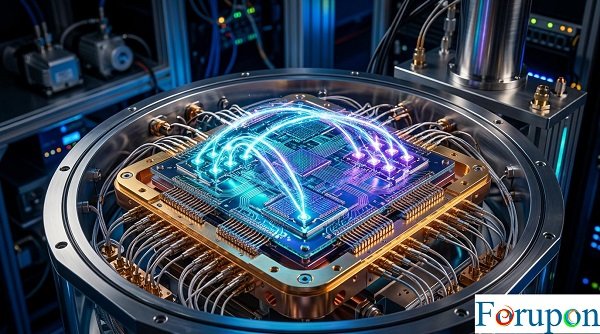
Quantum computers use quantum bits, commonly called qubits, to process information.
Unlike classical bits, which represent either 0 or 1, qubits can be prepared in quantum superpositions of computational basis states.
Quantum computers may offer advantages for particular classes of problems, but they are not universally faster than conventional computers.
Quantum Sensors
Quantum sensors use sensitive quantum properties to measure physical quantities.
Potential applications include:
-
Magnetic field measurement.
-
Gravitational field measurement.
-
Precision timing.
-
Navigation.
-
Medical research.
-
Geological exploration.
Some quantum sensing technologies are already established, while others are still undergoing research and development.
Quantum Communication
Quantum communication explores how quantum properties can be used to distribute information securely or establish cryptographic keys.
One important area is quantum key distribution (QKD), which uses quantum states to help detect certain forms of interception.
However, quantum communication does not automatically make every network or message completely secure. Practical security depends on implementation, hardware, protocols, and the surrounding communication system.
Quantum Computing: Why Is Everyone Talking About It?
Quantum computing is one of the most widely discussed areas of quantum technology.
Traditional computers process information using bits, which represent binary values of 0 and 1.
Quantum computers use qubits, which follow the principles of quantum mechanics.
A qubit can be prepared in a superposition of computational basis states, and quantum algorithms use quantum operations to manipulate those states.
How Are Qubits Different From Classical Bits?
Related Posts
| Feature | Classical bit | Quantum bit |
|---|---|---|
| Basic unit | Bit | Qubit |
| State | 0 or 1 | Quantum state involving 0 and 1 basis states |
| Superposition | No | Yes |
| Entanglement | No equivalent quantum property | Yes |
| Measurement | Reads binary value | Produces a probabilistic outcome |
| Main use | Conventional computing | Quantum information processing |
Potential Applications of Quantum Computing
Researchers are investigating quantum computers for several specialized applications.
Drug and materials research: Quantum computers may eventually help model certain molecular and material systems more effectively.
Optimization: Some quantum algorithms are designed to address specific optimization problems, although practical advantages over classical methods remain problem-dependent.
Scientific simulation: Quantum systems may be particularly useful for simulating other quantum systems.
Cryptography: Large-scale, fault-tolerant quantum computers could threaten some widely used public-key cryptographic systems. This is one reason organizations are transitioning toward post-quantum cryptography.
Are Quantum Computers Better Than Traditional Computers?
Not necessarily.
Quantum computers are specialized devices, not universal replacements for classical computers.
They may provide advantages for certain carefully defined computational tasks, but conventional computers remain better suited to most everyday computing requirements.
A practical quantum computing ecosystem is likely to involve cooperation between classical and quantum systems.
How Is World Quantum Day Celebrated?
World Quantum Day encourages people to explore quantum science through educational, scientific, and creative activities.
Because the initiative is decentralized, celebrations vary by country, organization, and community.
Some events are designed for professional researchers, while others are suitable for students and people with no scientific background.

Common World Quantum Day Activities
Science lectures and presentations
Universities and research organizations organize talks explaining quantum mechanics, quantum computing, and emerging technologies.
Educational workshops
Students can participate in introductory workshops that explain quantum physics using demonstrations and interactive learning.
Laboratory tours
Research institutions may provide opportunities to see scientific equipment and learn how quantum experiments are conducted.
Panel discussions
Scientists, engineers, educators, and technology professionals discuss research progress and future opportunities.
Online events
Webinars and virtual presentations allow people to participate without traveling to a physical location.
Artistic and creative activities
Artists and designers can explore quantum concepts through visual art, exhibitions, photography, and creative projects.
Why Do Organizations Participate?
World Quantum Day provides organizations with an opportunity to:
-
Promote scientific literacy.
-
Introduce students to quantum careers.
-
Share research developments.
-
Encourage interdisciplinary collaboration.
-
Increase awareness of emerging technologies.
-
Build connections between academia and industry.
The initiative also encourages scientists to communicate their research in language that non-specialists can understand.
How to Celebrate World Quantum Day in the USA
The United States has an active quantum research and education ecosystem involving federal agencies, universities, laboratories, and private technology companies.
Students, teachers, families, and organizations can participate in World Quantum Day in several ways.

For Students
Students do not need advanced mathematical knowledge to participate.
Useful activities include:
-
Learn the basic concepts of quantum mechanics.
-
Watch introductory lectures from university researchers.
-
Explore how quantum computers work.
-
Create a science presentation about Planck’s constant.
-
Participate in a university or community science event.
-
Explore introductory quantum programming resources.
For Teachers
Teachers can use World Quantum Day to introduce students to modern physics and STEM careers.
Suggested classroom activities:
-
Explain the meaning of Planck’s constant.
-
Demonstrate wave-particle duality using accessible educational examples.
-
Introduce the difference between classical bits and qubits.
-
Organize a quantum science poster competition.
-
Invite a physicist or engineering professional to speak.
-
Discuss how semiconductors use quantum mechanics.
For Families
Families can celebrate by exploring science together.
Ideas include:
-
Watch an introductory quantum science documentary.
-
Visit a science museum.
-
Read a beginner-friendly physics book.
-
Explore educational videos about atoms and photons.
-
Discuss how quantum physics relates to smartphones and computers.
For Universities and Research Institutions
Universities and research laboratories can organize:
-
Public lectures.
-
Quantum technology demonstrations.
-
Research open houses.
-
Student competitions.
-
Career discussions.
-
Interdisciplinary seminars.
For Businesses and Technology Organizations
Technology companies can participate by:
-
Sharing accessible educational content.
-
Organizing employee learning sessions.
-
Supporting STEM outreach.
-
Hosting demonstrations.
-
Discussing quantum technology applications.
-
Partnering with universities.
Where Can Americans Find Quantum Science Resources?
Several reliable US resources can help readers learn more.

National Institute of Standards and Technology (NIST)
Planck’s constant, measurement science, quantum research.

National Quantum Initiative
US quantum information science programs and resources.

National Science Foundation
Scientific research, education, and quantum-related programs.

IBM Quantum Learning
Beginner learning materials and quantum computing education.
The Role of the United States in Quantum Science
The United States is an important participant in global quantum research and technological development.
Its quantum ecosystem includes government agencies, academic institutions, national laboratories, and private-sector companies.
One major federal initiative is the National Quantum Initiative.
The initiative coordinates federal efforts to advance quantum information science and its applications.
What Is the National Quantum Initiative?
The National Quantum Initiative is a US government-wide effort designed to support American leadership in quantum information science and technology.
Its activities involve research, workforce development, infrastructure, and collaboration across federal agencies and research institutions.
The initiative recognizes three important areas of quantum technology:
-
Quantum computing.
-
Quantum communication and networking.
-
Quantum sensing and measurement.
The initiative also supports collaboration between universities, laboratories, government agencies, and industry.
For official information, visit The National Quantum Initiative.
Why Does Quantum Research Matter to the US?
Quantum research has potential implications for several strategic and scientific areas.
These include:
-
Advanced computing.
-
Scientific research.
-
Secure communication.
-
Precision measurement.
-
National security.
-
Workforce development.
-
Semiconductor and materials research.
However, translating laboratory breakthroughs into reliable, commercially useful systems requires sustained research, engineering, investment, and testing.
World Quantum Day helps bring these topics into broader public discussion.
The Future of Quantum Science and Technology
Quantum science is expected to remain an important area of research and innovation.
Although several quantum technologies are already established, many emerging applications are still under development.
The future of quantum technology will depend on improvements in hardware, error correction, measurement accuracy, engineering, and the ability to scale complex systems.
1. More Advanced Quantum Computers
Researchers are working to improve qubit stability, reduce errors, and develop fault-tolerant quantum computing systems.
These advances could make quantum computers more useful for specialized scientific and industrial applications.
2. Quantum Networking
Quantum networking research explores how quantum information can be distributed between different locations.
Potential applications include quantum communication networks and distributed quantum systems.
3. More Precise Quantum Sensors
Quantum sensing may improve the measurement of magnetic fields, gravity, time, and other physical quantities.
Such developments could support scientific research, navigation, healthcare-related research, and environmental monitoring.
4. Quantum Materials Research
Researchers are investigating materials with unusual electronic and magnetic properties.
A better understanding of these materials could support future developments in electronics, energy technologies, and quantum devices.
5. Quantum Education and Workforce Development
The expansion of quantum technologies creates a need for people with skills in physics, mathematics, engineering, computer science, and related disciplines.
Universities and educational organizations will play an important role in preparing future researchers and technology professionals.
World Quantum Day provides a useful opportunity to introduce these career possibilities to younger generations.
Why Should Everyone Learn About Quantum Science?
Quantum science is not exclusively for physicists or professional researchers.
Its principles are connected to technologies that influence communication, computing, measurement, medicine, and scientific discovery.
Understanding the basics can help people make sense of technological developments and distinguish realistic scientific progress from exaggerated claims.
For students, it can open doors to exciting STEM subjects.
For teachers, it provides an opportunity to introduce modern scientific ideas.
For professionals, it offers insight into emerging technological opportunities.
For the general public, it provides a better understanding of how scientific discoveries influence society.
That is the broader purpose of World Quantum Day: making an important field of science more accessible, understandable, and relevant to everyone.
12. Frequently Asked Questions About World Quantum Day
1. What is World Quantum Day?
World Quantum Day is an annual international science-awareness initiative celebrated on April 14. It promotes public understanding of quantum mechanics, quantum science, and emerging quantum technologies through educational events, lectures, workshops, and scientific activities.
2. When is World Quantum Day celebrated?
World Quantum Day is celebrated every year on April 14. The date represents the rounded first three significant digits of Planck’s constant when expressed in electronvolt-seconds.
3. Why is April 14 called Quantum Day?
April 14 represents 4.14, which corresponds to the rounded value of the first three significant digits of Planck’s constant: approximately 4.14 × 10⁻¹⁵ eV·s.
4. When was the first World Quantum Day?
The initiative was launched on April 14, 2021, and the first global World Quantum Day celebration took place on April 14, 2022.
5. Who started World Quantum Day?
World Quantum Day was initiated by an international community of quantum scientists. It is a decentralized initiative that encourages scientists, educators, engineers, researchers, and other organizations to organize their own celebrations.
6. What is the main purpose of World Quantum Day?
Its main purpose is to make quantum science and technology more accessible to the public, encourage scientific curiosity, highlight technological developments, and inspire future generations to explore quantum research.
7. What is Planck’s constant?
Planck’s constant is a fundamental constant of quantum physics represented by the symbol h. It connects the energy of a photon with its frequency through the equation E = hf.
Its exact SI value is 6.62607015 × 10⁻³⁴ joule-seconds.
8. What is quantum science in simple terms?
Quantum science studies how matter and energy behave at extremely small scales, including atoms, electrons, and photons. It helps explain phenomena such as superposition, entanglement, and quantized energy.
9. Why is quantum physics important in everyday life?
Quantum physics provides the scientific foundation for many modern technologies, including semiconductor chips, lasers, atomic clocks, and other electronic and measurement devices.
10. How can students celebrate World Quantum Day?
Students can celebrate by attending science lectures, watching educational videos, exploring quantum computing, participating in physics demonstrations, creating science posters, or organizing classroom presentations.
11. Is World Quantum Day celebrated in the United States?
Yes. The United States participates in World Quantum Day through educational activities, research events, university programs, and science-awareness initiatives. Federal science agencies have also provided educational resources for the occasion.
12. What is the difference between quantum physics and quantum computing?
Quantum physics is the scientific theory describing the behavior of microscopic systems. Quantum computing is a technology that uses quantum mechanical properties to process information using qubits.
Quantum computing is one application of quantum physics, not another name for the entire field.
13. Are quantum computers faster than regular computers?
Not for every task. Quantum computers may offer advantages for particular computational problems, but conventional computers remain more suitable for most everyday applications.
14. What are the three main areas of quantum technology?
Three major areas are quantum computing, quantum communication, and quantum sensing. Each uses quantum mechanical properties for different technological purposes.
15. Is World Quantum Day the same as the International Year of Quantum Science and Technology?
No. World Quantum Day is an annual celebration held on April 14. The International Year of Quantum Science and Technology was a separate United Nations-designated observance that took place throughout 2025.