
Radius Of Earth – Radius, Diameter and Circumference


Contents
hide
The Radius of the Earth
For upon |If we talk about the earth then we can say that Earth is the nearly spherical ball and the only known planet of the solar system on which life exists. In addition, Earth is not completely round and it’s in the shape of an orange. In this topic, we are going to discuss the various things that help us to find the radius of the earth.
What is Earth?
The Earth is the third planet of our solar system and galaxy known as the Milky Way. Furthermore, it is the only known planet where life exists. Also, the earth provides a protective environment for living things. So, they can exist in this suitable environment.
Besides, the distance between the sun and the earth is also a factor that supports life on earth.

What is the Radius of the Earth?
Radius refers to a line that connects the center point of a circle to any point on its outside layer. In simple words, radius refers to that line, which originates from any point of the circle and touches the center point of the circle.
Most noteworthy, if we double the radius (the diameter of the circle) then it divides the circle into two equal halves. Also, the diameter is the maximum distance between the two points of the circle.
What Does the Earth Look Like?
If we talk about the appearance of the earth from outer space then we see a blue planet with white whirls and areas of yellow, green, brown, and white.
In addition, the blue area is water (oceans and seas), the white whirls are clouds and yellow, brown, and green are landforms.
Besides, the white area is the snow caps or north and south poles (Antarctica and Arctic). Also, the equator is the imaginary line that divides the earth into two equal halves.
Furthermore, the southern half of the planet is Southern Hemisphere and the north half is the Northern Hemisphere. Most noteworthy, the north most point is the North Pole and the southernmost point is the South Pole.
How to Find the Radius of the Earth?
During the 3 century, B.C. Eratosthenes was able to mathematically calculate the diameter of the earth by comparing the difference in the angle of the sun’s rays at different geographic points. He was the first person that was able to calculate the radius of the earth.
In addition, he was able to determine the circumference of the earth because he knew the distance between the two locations (Syene {present day Aswan, Egypt} and Alexandria). Furthermore, with the circumference, he drives the diameter and radius.
For measuring the radius of the earth compute the circumference of the earth. Do this by taking the example of Eratosthenes and finding the distance and angle between two locations.
Since the distance between the two locations can be an arc measurement of the 360-degree circle. The arc in the Eratosthenes case was 7.2 degrees and the distance between the two locations is 787 kilometers.
So, for him the following relationship between objects will apply: 7.2 / 360 = 787 / x.
Here x is the circumference of the earth. On solving the circumference of the earth we get 39,350 kilometers.
So the radius of the earth will be
Circumference = 2πr
39,350 = 2 × 3.14 × r
r = 39350/ 6.28 = 6267 kilometer.
Solved Question for You
Question. Which of the following is not required to find the radius of the earth?
A. The distance of two location
B. Pie (π)
C. Circumference
D. length of the radius
Answer. The correct answer is option A. Because the distance between two locations relates to the circumference of the circle.
The article was originally published here.
How to Find the Radius of the Earth
Related Posts
In the third century B.C., Eratosthenes was able to mathematically calculate the earth’s diameter by comparing differences in the angle of the sun’s rays at two separate geographic points. He noticed that the difference in the angle of a shadow in his location at Syene, which is present-day Aswan in Egypt, and that of a shadow in Alexandria was about 7.2 degrees. Since he knew the distance between the locations, he was able to determine the circumference of the earth, and therefore the diameter and radius as well. You can do this, too, by using his method.
Record the distance between your location and your partner’s location. As an example, we will use Eratosthenes’ situation. The distance between Syene and Alexandria is 787 kilometers.
Drive one of the meter sticks into the ground in your location in a sunny spot. Tack one end of a piece of string to the top of the stick. Have your partner do the same in her location. Make sure both sticks are perpendicular to the earth and that the same length of stick protrudes from the ground.
Measure the angle of the shadow of your meter stick when the sun is overhead and the shadow is smallest. Place the loose end of the string at the end of the cast shadow and hold it taut. Use the protractor to measure the angle where the string meets the stick at the top. Have your partner do the same in her location at the exact same time. Record the measurements.
Subtract the angle measurements to determine the difference in the angle of shadows between the two locations. For Eratosthenes, at midday on the summer solstice where the sun’s angle was directly overhead, the angle was zero. Though he did not have instant communications as we do now, he was able to determine the angle of the sun’s rays in Alexandria at the same time, which was about 7.2 degrees. Therefore, the difference was 7.2 degrees.
Compute the circumference of the earth using the distance and angle measurements you have. Since the locations are points on a circle that goes around the earth, the distance between them can be expressed as an arc measurement on a 360-degree circle. For Eratosthenes, the arc was 7.2 degrees. The distance between locations is also part of the total circumference of the earth. In Erastothenes’ case, the distance was 787 kilometers, so for him, the following relation applied: 7.2 / 360 = 787 / x, where x = the circumference of the earth in kilometers. Solving for x reveals the circumference of the earth to be 39,350 kilometers.
Compute the radius of the earth using the formula C (circumference) = 2 x pi x r (radius). Erastosthenes’ formula would look like this: 39,350 = 2 x 3.14 x r, or 6,267 kilometers.
Things You’ll Need
- Partner in a distant location at about the same longitude or in the same time zone
- Mobile phone
- 2 poles 1 meter long
- Measuring tape
- 1 2 strings at least 1.5 meters long
- 2 tacks
- 2 protractors
- Calculator
Tips
- Use a scientific calculator. Since pi is an infinite number, the calculations in Step 6 will be more accurate.
You must measure the angle of shadows in the two locations at the exact same time on the exact same day or the calculations will be erroneous.
Warnings
- Because these measurements are not done with more sensitive equipment, the radius calculation will be only approximate. The actual radius of the earth is 6,378.1 kilometers at the equator, but the radius varies because the earth is a somewhat flattened sphere. The radius is more like 6,371 kilometers at the north and south poles.
The article was originally published here.
High School Students Measure New Value for Earth’s Radius to Celebrate World Physics Year
| Andrew Blum gives some pointers to students in his high-school class in Clinton, Mississippi as they work on the Eratosthenes project. |
Has the radius of Earth mysteriously grown by about 3%? According to data taken by 183 high-school classes participating in a World Year of Physics project, “Measure the Earth with Shadows”, the radius of Earth is 6563 km, compared to the accepted value for the mean radius of 6371 km.
Of course, no one is claiming the size of Earth has actually changed. “Most of the data submitted was remarkably good,” said Jennifer Fischer, the APS project leader. “It is nice to see that measurements taken by so many groups, sometimes in less than ideal conditions, came so close to the right answer.”
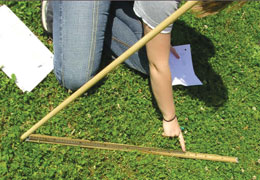
The data were submitted by high school classes all around the US, as well as some in Canada and Mexico, working in pairs. Each pair measured the angle of the sun, in the same way, that the Greek philosopher Eratosthenes did more than 2000 years ago in Alexandria, Egypt–by comparing the length of an object to the length of its shadow, measured at local noon.
Eratosthenes made his measurement on the summer solstice and had the additional knowledge that on that day the sun was directly overhead at a location a known distance south of Alexandria, on the Tropic of Cancer. This enabled him to compute the Earth’s radius. In the current experiment, each pair of high schools used the known north-south distance between them and the angle of the sun at each location to determine the radius.
For various reasons, about one-sixth of the schools were unable to work with their assigned partner school, but they did the measurement anyway, on the vernal equinox, using the knowledge that the sun is directly overhead at the equator on that date.
“The Eratosthenes Project really gets kids to think in a special way,” Fischer said. “Most kids learn in school that the Earth is round, but they never really picture it in their heads as if they were in outer space. This project forces you to imagine the solar system as if looking down on it from the outside. Learning to think imaginatively and creatively like this is an important part of physics.”
Rebecca Messer, a physics teacher in Northfield, Minnesota, wrote in an email “My students were thrilled to be part of this experiment and were very diligent in their measurements. We ran 5 stations; they each used a level to plant their dowel and to level the horizontal when they measured the shadow lengths.”
The class of physics teacher Brent McDonough in Edmonton, Alberta, had two US partners, one in Henderson, Nevada and the other in Calexico, California. “We had a great time working with all three schools and have even exchanged email photos of each class and posted them on our school website with a report of the project,” McDonough said.
 |
The project’s influence has spread to the southern hemisphere. An Argentine physicist, Silvia Ponce Dawson, writes “I’ve found the Eratosthenes project that you’ve launched on the occasion of the World Year of Physics really fascinating and I would like to have it done in my country too.” As a first step, she has translated the APS teacher’s guide for the project into Spanish.
Participating students each received a World Year of Physics pin, and their classes received a commemorative certificate. More details of the project, including the teacher’s guide and a map showing the distribution of participating US schools, can be found on the World Year of Physics website.
The article was originally published here.
TO GET MORE KNOWLEDGE ABOUT Website Designing Company, PLEASE VISIT OUR SITE: forupon.com.
Comments are closed.