
Email Marketing for Restaurants: A Practical Guide for US Operators

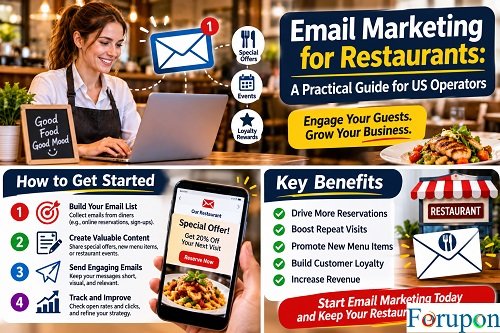
Email marketing for restaurants means collecting permission-based email addresses from guests and sending them useful messages that bring them back: offers, menu news, events, reservations, and rewards. It works because you reach people who already chose to hear from you, on a channel you control rather than one an algorithm controls.
This guide covers how to build a list, what the law and inbox providers require, which emails to send, how to measure results honestly, and a 30-day plan to get started. Where a statistic is used, the source and its limits are stated.
What Is Email Marketing for Restaurants?
Restaurant email marketing is the practice of sending marketing and relationship emails to guests who have opted in. Messages typically fall into three groups:
- Promotional: specials, limited-time menu items, holiday offers
- Relationship: welcome emails, birthday offers, loyalty updates, thank-you notes
- Transactional: reservation confirmations and order receipts
Transactional emails are treated differently under US law (see below), but they are also a chance to reinforce your brand.
Restaurants have an advantage over most businesses: they are local, and guests have a real experience of the place. Email lets you turn a one-time visit into a habit.
Does Email Marketing Work for Restaurants?
Short answer: yes, usually, but the headline numbers are looser than most articles admit.
What the data supports:
- Return on investment. Litmus’s State of Email research is the source of the widely repeated figure of $36 returned per $1 spent. Its 2025 survey breakdown reports that 35% of marketing leaders see $10 to $36 per dollar, 30% see $36 to $50, and 5% see more than $50. This is a cross-industry survey of marketers, not restaurant-specific data, and the figures are self-reported.
- Guest appetite. A HungerRush survey, reported by Twilio SendGrid, found that 75% of consumers want to hear from their favorite restaurants and 25% will dine within a week of receiving a marketing message. Treat this as survey sentiment, not a guarantee of results.
- Engagement. MailerLite’s 2025 benchmarks, based on 3.6 million campaigns, show restaurants and cafes averaging a 44.32% open rate, a 1.06% click rate, and a 3.28% click-to-open rate. The all-industry click rate was 2.09%, so restaurant clicks trail the average even though opens look healthy.
What to be careful about: Other sources report very different restaurant figures. One roundup citing OptinMonster lists a 32.54% open rate and a 0.81% click rate for dining and food services. Differences come from list quality, platform mix, and how each vendor counts opens. Apple Mail Privacy Protection inflates open rates, so click rate and revenue are more reliable signals.
Bottom line: email is low-cost and high-leverage for a restaurant with repeat guests, but your own results, not an industry average, are what count.
How to Build a Restaurant Email List
No list, no campaign. Collect addresses with clear permission at every point where guests already interact with you.
- Online reservations and ordering. Add an optional, unchecked opt-in box. Guests who book or order are your warmest prospects.
- On-premise QR codes. Place a code on tables, receipts, or check presenters that leads to a one-field signup page.
- Your website. Put a short signup form in the footer and a clear page for it. Pop-ups can work, but keep them light on mobile.
- Loyalty program signup. Ask for email as part of joining a rewards program.
- Events. Collect addresses at wine dinners, tastings, and private events, with explicit opt-in.
- Staff prompts. A server saying, “We email our specials a couple of times a month; want to join?” often outperforms a passive sign.
Offer a reason to join. A birthday treat, early access to seasonal menus, or event invitations works better than “subscribe to our newsletter.”
Do not buy or scrape lists. Purchased lists generate spam complaints, which damage deliverability (see below). Consolidate the guest data you already own from reservation tools, POS, loyalty apps, and paper sheets, but only email people who have agreed to marketing.
Legal and Deliverability Basics
This is general information, not legal advice. Check the current rules with a qualified attorney for your situation.
CAN-SPAM Act (federal law)
The FTC enforces CAN-SPAM, which applies to commercial email, including a single message to a past customer. According to FTC guidance, each separate violating email can carry penalties of up to $53,088. The core obligations, as the FTC and compliance guides describe them:
- Use accurate sender and routing information
- Do not use deceptive subject lines
- Make clear the message is an advertisement
- Include a valid physical postal address
- Provide a clear way to opt out
- Honor opt-outs promptly (compliance guides cite within 10 business days) and never charge for opting out
- Monitor anyone sending on your behalf, such as an agency
Gmail, Yahoo and Microsoft sender rules
Since February 2024, Google and Yahoo have required bulk senders (5,000 or more messages per day to their users) to authenticate with SPF, DKIM and DMARC, offer one-click unsubscribe honored within two days, and keep spam complaints below 0.3%, ideally below 0.1%. Microsoft Outlook has added matching expectations, reportedly from May 2025. Most single restaurants send far fewer than 5,000 emails a day, but guidance indicates that SPF or DKIM authentication matters for all senders, and mailbox providers judge reputation regardless of volume.
Practical steps:
- Send from a branded domain (for example
hello@yourrestaurant.com), not a free Gmail address - Ask your email platform to walk you through SPF, DKIM, and DMARC setup
- Keep a visible unsubscribe link and honor requests immediately
- Check Google Postmaster Tools if your volume is high
Types of Restaurant Emails to Send
Each email should have one job and one next step.
| Email type | Trigger | Goal | Example subject line |
|---|---|---|---|
| Welcome | New signup | Set expectations, give a first reason to visit | “Welcome. Here’s a dessert on us” |
| Birthday or anniversary | Date on file | Drive a celebration visit | “Your birthday table is waiting” |
| New menu or seasonal | Menu change | Create interest and trial | “Our fall menu starts Thursday” |
| Event | Wine dinner, live music, holiday | Reservations or tickets | “12 seats left: Chef’s tasting night” |
| Loyalty update | Points milestone | Encourage a return visit | “You’re one visit from a free entrée” |
| Win-back | No visit in a set period | Reactivate lapsed guests | “We’ve missed you. Come back this week” |
| Reservation and order | Booking or purchase | Confirm, reduce no-shows | Transactional, plain and clear |
| Feedback | After a visit | Collect reviews, catch problems | “How was your visit?” |
| Newsletter | Regular schedule | Stay top of mind | Behind-the-scenes, team stories, local news |
The subject lines are illustrative, not tested results. Test your own.
How to Segment Your Restaurant Email List
Segmentation means sending different messages to different groups. Even basic segments help:
- New vs. returning guests: a welcome offer for newcomers, a loyalty nudge for regulars
- Dine-in vs. takeout and delivery: do not send a patio-dining promo to pure delivery customers
- Location: essential for multi-location brands
- Visit recency: win-back emails for guests who have lapsed
- Event interest: people who attended a tasting get the next tasting invitation first
Segmentation depends on having usable guest data, so connecting your POS, reservation, and ordering tools to your email platform pays off.
How Often Should a Restaurant Send Emails?
Related Posts
There is no verified universal number. As a starting point, many restaurants do well with one or two promotional emails a month plus automated emails (welcome, birthday, win-back). Increase only if clicks and redemptions hold up while unsubscribes and spam complaints stay low. For timing, test your own audience. Popular claims about the “best day” differ between sources and are not reliable guidance for your guests.
How to Write a Restaurant Email That Gets Action
- Lead with the offer or news. Put the reason to open in the subject line and the first line.
- One call to action. “Book a table,” “Order now,” or “Claim your reward.” Pick one.
- Write for phones. Most guests will read it on a phone: short text, large button, one or two strong photos.
- Use real food photos. Appetizing images from your own kitchen beat stock images.
- Make it trackable. Use a unique promo code or link per campaign so you can attribute visits and orders.
- Sound like your restaurant. A casual neighborhood spot and a fine-dining room should not sound the same.
Illustrative welcome email (adapt freely):
Subject: Welcome to [Restaurant Name]. Your first dessert is on us
Thanks for joining the list. Here’s what to expect: our seasonal menu updates, the occasional event invitation, and a birthday treat. Show this email on your next visit for a complimentary dessert with any entrée. [Book a table]
[Restaurant name, street address, city, state, ZIP] | Unsubscribe
How to Measure Restaurant Email Marketing
| Metric | What it tells you | Caution |
|---|---|---|
| Click rate | Interest in your offer | More reliable than opens |
| Open rate | Subject line and sender appeal | Inflated by Apple Mail Privacy Protection |
| Redemptions (promo codes, links) | Real visits and orders | Needs tracking set up in advance |
| Revenue per recipient | Money earned per email sent | Best single measure if you can attribute sales |
| Unsubscribe rate | List fatigue | MailerLite reported a higher all-industry average in 2025 (0.22%) than in 2024 (0.08%) |
| Spam complaint rate | Deliverability risk | Keep below 0.1% where possible, never reach 0.3% |
| List growth | Whether capture methods work | Track by source |
Benchmarks to use cautiously: MailerLite’s 2025 restaurant and cafe figures (44.32% open, 1.06% click) are one data point. Use industry numbers for orientation, then compare each campaign against your own history.
How to Choose an Email Platform
Platforms mentioned in current guides include Mailchimp, Toast (for restaurants already on Toast POS), Brevo (email plus SMS), ChowNow, Constant Contact and Square. Pricing and features change often and were not verified for this article, so compare current plans directly. Look for:
- POS, reservation, and ordering integration so guest data flows in automatically
- Automation for welcome, birthday, and win-back emails
- Segmentation by visit behavior
- Built-in compliance (unsubscribe handling, authentication setup)
- Reporting that shows sales, not just clicks
- Cost that suits your list size
An integrated tool is often easier for a small team, while a general platform may offer more design flexibility.
Common Mistakes
- Sending to anyone with an email address. Fix: email only guests who opted in.
- Discount-only messaging. Fix: mix offers with menu stories, events, and recognition.
- No tracking. Fix: add unique codes or links per campaign.
- Ignoring mobile. Fix: preview every email on a phone.
- Inconsistent sending. Fix: automate the essentials and keep a simple calendar.
- Skipping authentication. Fix: set up SPF, DKIM, and DMARC.
- Hiding the unsubscribe link. Fix: make it obvious. It protects your reputation.
- Judging by opens alone. Fix: lead with clicks, redemptions, and revenue.
A 30-Day Launch Plan
Week 1: Foundation. Choose a platform, set up a branded sending domain and authentication, add your physical address and unsubscribe link, and import consented contacts.
Week 2: Capture. Add sign-up to your website, reservation, and ordering flows. Print a QR code for tables and receipts. Brief your staff on a simple one-line invite.
Week 3: Automate. Build a welcome email and a birthday email. Add a unique code to each.
Week 4: Send and learn. Send your first promotional email with one clear call to action. Review clicks, redemptions, and unsubscribes, then plan the next send.
Frequently Asked Questions
Is email marketing worth it for a restaurant?
Usually yes. It is low cost, reaches guests who opted in, and supports repeat visits. Cross-industry research from Litmus reports high average returns, but those figures are not restaurant-specific, so track your own results.
How do I get email addresses from restaurant guests?
Ask with clear permission at reservation, online ordering, loyalty signup, events, QR codes, and your website. Offer a reason to join, such as a birthday treat or early access.
How often should a restaurant send marketing emails?
There is no proven universal answer. A common starting point is one or two promotional emails a month plus automated emails, then adjust based on clicks, redemptions, and unsubscribes.
What is a good open rate for restaurant emails?
It depends on the source. MailerLite’s 2025 data shows 44.32% for restaurants and cafes, while other roundups report lower figures. Because Apple Mail Privacy Protection inflates opens, focus on click rate and revenue.
Is restaurant email marketing legal in the US?
Yes, if you comply with the CAN-SPAM Act: accurate sender details, honest subject lines, a physical address, a clear opt-out, and prompt honoring of opt-outs. This is general information, not legal advice.
Should restaurants use email or SMS?
They do different jobs. Email suits richer content such as menus, events, and newsletters, while SMS suits short, time-sensitive messages. SMS has its own consent rules, so confirm requirements before texting guests.
Conclusion
Email marketing for restaurants pays off when it is built on permission, sent with a clear purpose and measured by visits and revenue rather than opens. Start with a compliant list and a branded, authenticated sending domain, automate welcome and birthday emails, and send one focused message at a time. Then use your own results to decide what to do more of.